
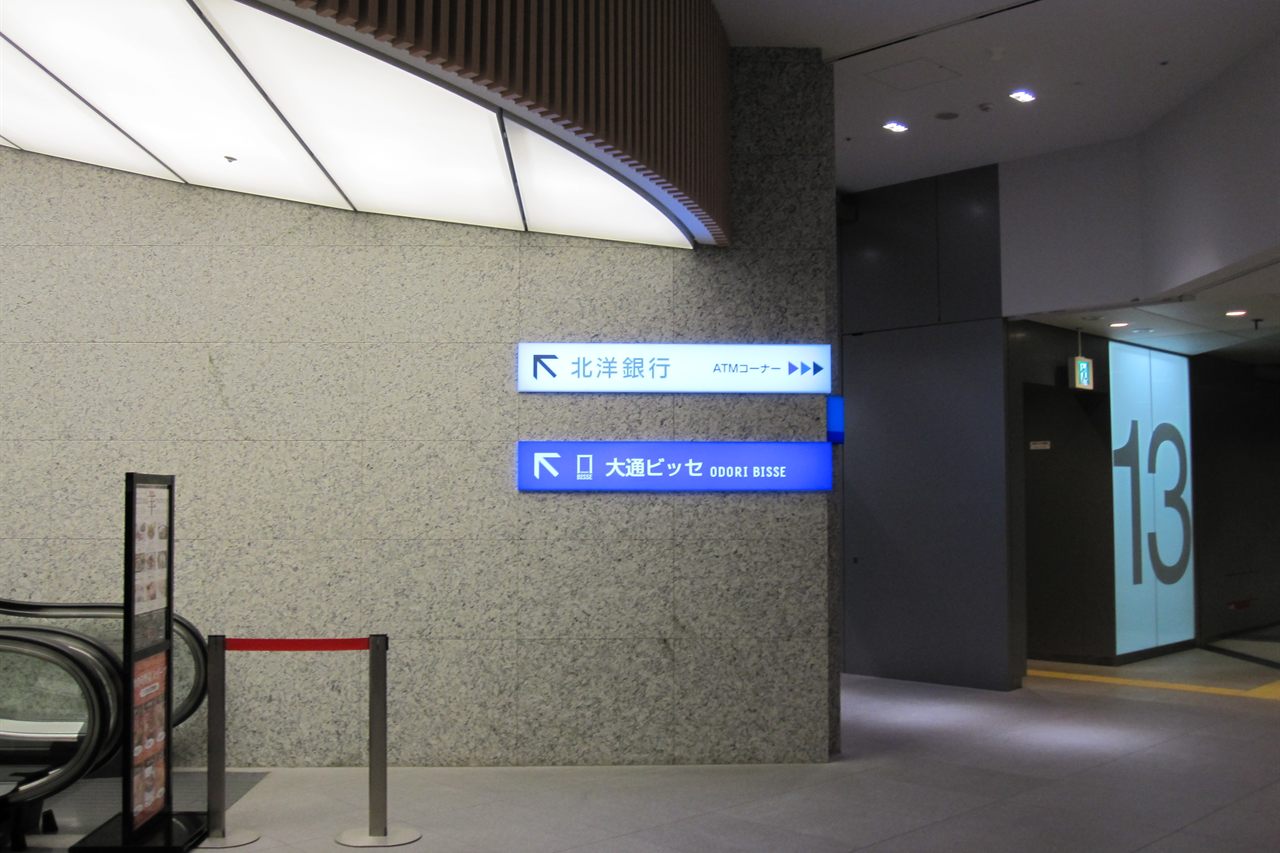
An underground entrance can look reassuring when rain or snow starts in Sapporo. Going downstairs, however, does not automatically reveal the route to your destination. JR stations, subway stations, passages and shopping streets connect here, and the word “Sapporo” can refer to different places along the way.
A connected walking network with distinct named sections, not a scale map.
Find the underground route toward subway Sapporo.
Locate the entrance to Chi-Ka-Ho toward Odori.
This named passage connects subway Sapporo and Odori.
Recheck signs here before continuing south.
Continue through the separate Pole Town section, if it suits your destination.
Confirm the correct surface exit and building entrance locally; this diagram gives no exit or floor number.
Chi-Ka-Ho is the nickname for the Sapporo Ekimae-dori Underground Walkway. Start by saving your actual starting point and the name of the building you want to enter. This guide makes the north–south connections and exit signs easier to use on a first walk.
Think of the underground as a route, not one large station
JR Sapporo Station, subway Sapporo Station, Chi-Ka-Ho, Odori and the shopping passages farther south are not one facility with one name. A ticket gate is for entering the paid train area; it is not something you must pass whenever you walk to another building. Separate “take a train” from “follow the passage” to choose the right arrows.
Building entrances and open spaces connect the below-ground walk with the city above. Even if you stop to look at a display, check your location at a junction. Following the place names on a map is more useful when lost than memorising a single exit number without its station.
The rain avoided in the passage is separate from rain after the exit. Check whether the destination connects directly underground or needs a final street walk. An “underground route” does not guarantee a dry walk to the hotel door. A building entrance’s hours can also differ from the passage’s hours.
What exactly is Chi-Ka-Ho?
It is the underground pedestrian space between Subway Sapporo Station on the Namboku Line and Odori Station. Sapporo’s official visitor guide puts this section at about 520 metres, roughly a 10-minute walk.
That estimate covers the walkway, not the whole journey from a JR platform to your hotel room. Add time for station corridors, finding an exit and walking outside.
Think of the walk in four parts
- JR Sapporo Station: follow signs towards Subway Sapporo Station and Odori.
- Sapporo to Odori: head south through Chi-Ka-Ho.
- Beyond Odori: check signs for the connected underground shopping area towards Susukino.
- The final exit: match the exit with the actual entrance of your destination.
JR Sapporo Station and the Susukino area are connected underground, but the entire route is not called Chi-Ka-Ho. Different names on the signs do not necessarily mean you have taken a wrong turn.
It is not open all night
The published passage hours are 5:45 a.m. to 12:30 a.m. the following day. The operator says passage is unavailable outside those hours. For an early start or late return, plan a street-level route too.
A connected building or hotel entrance may keep different hours. Check the building’s own access information rather than assuming every door stays open as long as the walkway.
Follow destinations, then choose an exit
- From JR Sapporo: leave the JR ticket gates and look for pedestrian signs towards Subway Sapporo on the Namboku Line and Odori. The JR platforms and Chi-Ka-Ho are separate parts of the journey.
- Along Chi-Ka-Ho: keep following Odori signs. You do not need to enter a subway ticket gate simply to walk through the pedestrian passage.
- At Odori: decide whether to leave for the street or continue towards Susukino. For the latter, signs for Pole Town (ポールタウン) help identify the connected shopping passage.
- Near your destination: match the exit with the building entrance. Once outside, check a building name and the nearest junction before walking away.
Underground, a phone map may not make your direction clear. Look for 現在地, “you are here,” on a physical map and match nearby exit numbers or buildings. A destination name and an arrow are more useful than guessing which way is south.
If an exit is closed or you lose your bearings
Read the local diversion notice rather than assuming the next exit reaches the same side of the road. Recheck the crossing and building entrance at street level. If you are unsure, show someone your destination’s Japanese name and address, not only the district name.
Useful question: “この建物へ行くには、どの出口が近いですか?” — “Which exit is near this building?” If you need step-free access, add “階段を使わずに行きたいです” — “I need a route without stairs.”
Japanese words to recognise
| On the sign | Meaning / what to check |
|---|---|
| 現在地 | You are here: your position on the map. |
| 出口 | Exit to the street or a building. Keep the station name with its number. |
| 地上 | Street level, above the underground passages. |
| エレベーター | Elevator / lift. Check which floors it connects. |
| 階段 | Stairs. Choose another route if steps do not suit your needs. |
| 閉鎖・通行止め | Closed / no passage. Follow the diversion signs. |
Official station maps: how to use them
These are official maps with Japanese labels (PDF). Choose the station, zoom in on your exit number, then look for エレベーター (elevator). Trace platform to gate and gate to street separately. The Japanese key above explains the words you need; you do not have to translate the entire map.
With a suitcase, choosing the exit becomes part of the itinerary
Imagine walking from JR Sapporo Station to a hotel near Odori with a large suitcase. Before choosing the nearest stairs, find a lift to street level and the pavement route to the entrance. A slightly different route may be easier once carrying the bag up stairs is included.
Write a route note as “starting point → passage → street exit → building entrance”. On the official station map, trace the platform-to-gate section separately from the gate-to-street section. Read the station name along with the number: Exit 3 at another station is a different location.
If an exit or building entrance is closed, use the local map to establish where you are. Show staff the destination address and ask for an available exit. Switching once to a street-level route can be simpler than repeatedly walking back underground. For late returns, keep an alternative that does not rely on the passage being open.
You do not need to memorise the whole network. Use your current location, destination and final exit to understand the part you need that day, then build your picture of Sapporo one connected walk at a time.
Small details that make the day easier
The underground squares are worth a calendar check
Chi-Ka-Ho’s official site lists exhibitions and small markets by date and square. Use it for a possible stop on an existing walk, then check the organiser’s details. It is not a promise that a stall from an old social photograph is there every day.
Save the square’s name and east/west side rather than only “Chi-Ka-Ho”. Keep a limit for the detour before a restaurant booking or train. If nothing appeals on your date, the route still works as a walk; you do not need to add a separate journey just to fill the calendar.
A lost item may belong to a different manager
For items lost inside Chi-Ka-Ho, the manager directs enquiries to the disaster-prevention centre, 011-231-1201, beyond the west North 2 intersection square between entrances 6 and 8. A loss on a subway train or inside a connected shop is a different location to identify.
Write where you last used the item, the approximate time and a description before asking. If you are unsure which area it was, show the route you walked rather than saying only “Sapporo underground”. Keep rubbish with you where no appropriate bin is provided; connected shops’ bins are not a city-wide disposal service.
Official sources checked 3 October 2026: Chi-Ka-Ho events / Lost-property FAQ
Official information and scope
This guide combines official information and planning proposals. No newly added passage claims a firsthand visit or ride. Check fares, services, opening hours and facility conditions for your travel date.
Changing from JR to the subway? Use our Namboku and Toho transfer guide. For photos and luggage in shared passages, see Sapporo travel etiquette. If your 2026 autumn or winter walk includes an exhibition or lights, match your travel date to the specific event venue and period.