
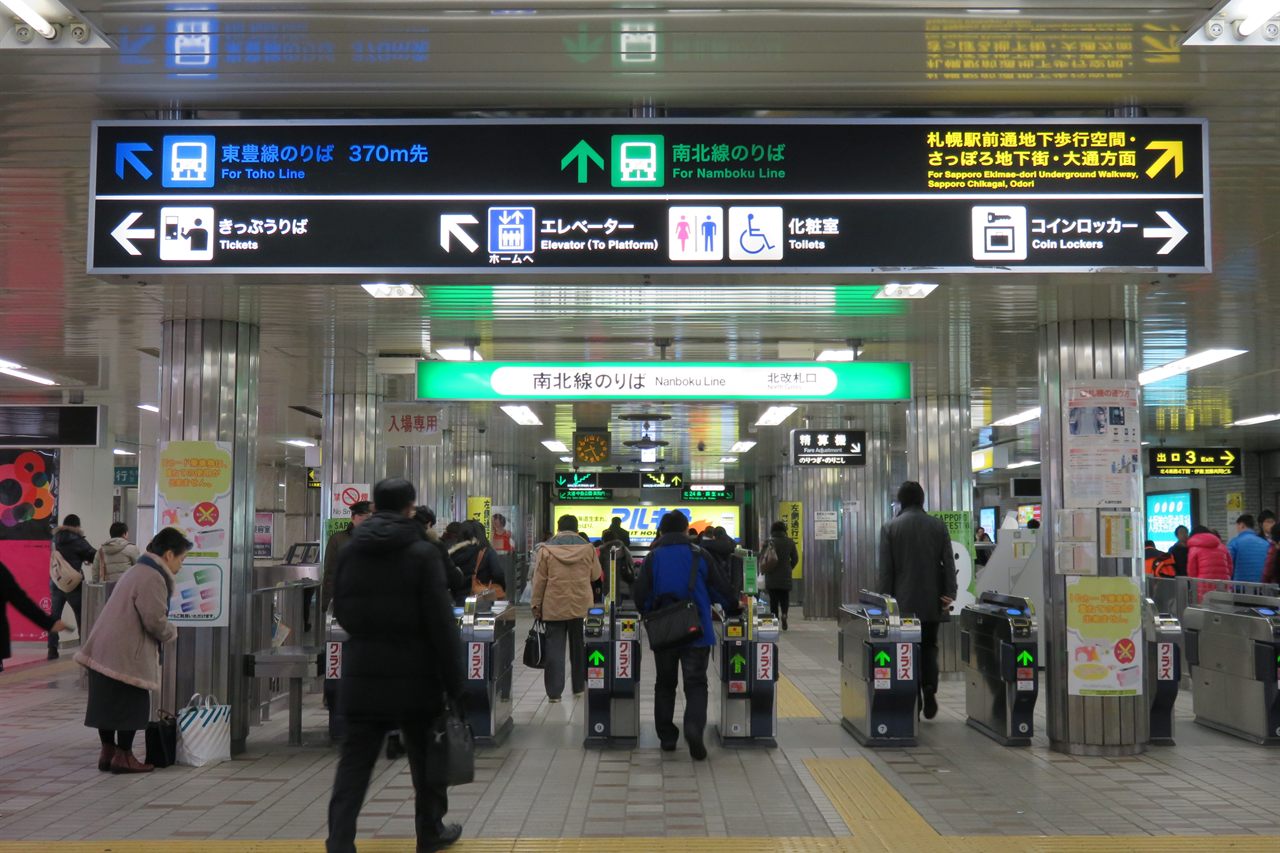
Buy Sapporo’s subway day tickets with cash at a subway station ticket machine. On Saturdays, Sundays, public holidays and December 29–January 3, the subway-only Donichika costs ¥520 for an adult; on other days, the standard subway-only day ticket costs ¥830. Neither covers JR, buses or streetcars. Add up the subway rides you will actually take before deciding whether a pass saves money.
Count only rides you will actually take on the subway.
Check weekday or eligible holiday rules and adult/child category.
Total the ordinary fares for confirmed subway legs only.
Check the current one-day or Donichika ticket conditions for that date.
For eligible adult contactless bank-card rides, check the operator’s daily cap and use the same payment device.
JR, buses and streetcars sit outside this subway comparison. Recheck official fares and eligibility.
First, write the places you will visit in order, from leaving the hotel to returning. Add the ordinary fares for the subway legs only, then compare them with the pass available on your travel date. This guide takes that decision through buying a ticket, passing the gate and finding the correct platform direction.
A pass can simplify the day, but the saving is a separate question
You do not need to know the ride count immediately. Put the morning destination, lunch, afternoon destination and hotel on a map, then separate walking from subway legs. Different area names do not automatically mean another train ride. Returning to the hotel between outings, however, can add a journey.
A valid pass can make it easier to travel within its coverage without choosing a fare each time. Whether it saves money is a different calculation. Write the confirmed fare total separately from “I may take the subway back if tired”; you can then see what benefit you are buying.
Keep a paper pass until the day’s subway travel is finished. A gate, or kaisatsu, is the boundary into or out of the paid station area. Collect the pass when the gate returns it, and store it away from shopping receipts so it is easy to find at the next station.
Compare the two tickets
Donichika: adults ¥520, children ¥260. Valid on Saturdays, Sundays, public holidays and December 29–January 3.
The standard subway-only one-day ticket can also be used on weekdays: adults ¥830, children ¥420. Both cover the Sapporo subway, not JR trains, airport buses or streetcars.
Bring cash to buy the pass
The transport bureau states that these tickets are purchased with cash, not IC-card balance, SAPICA points or credit cards. Donichika is sold at subway ticket machines, station offices and commuter-pass sales offices.
Ask staff before entering the gates if you are unsure. Prices and purchase conditions checked November 1, 2026; consult the official links before use.
Your first subway ride, step by step
- Identify the line and station. Sapporo has the Namboku, Tozai and Toho subway lines. “Sapporo” alone does not distinguish the subway from JR. Save both the line and destination station.
- Buy before entering the gates. At the machine, check the ticket name, valid day, adult/child category and quantity. Show staff “ドニチカキップ” for Donichika or “地下鉄専用1日乗車券” for the standard subway day ticket if the screen is unclear.
- Use the paper-ticket slot. It is separate from the IC-card reader. Collect your day ticket when the gate returns it and keep it for later rides. Do not also tap an IC card for the same trip.
- Check the direction before boarding. Match the line, direction and your stop on the platform route diagram.
- Choose an exit after arrival. The useful exit may be some distance from your carriage. Find the elevator route before committing to stairs with luggage.
Why the sign says Makomanai when you want Odori
On the Namboku Line, travel from Sapporo towards Odori and Susukino in the Makomanai direction: 真駒内方面. For the return from Odori or Susukino to Sapporo, look for 麻生方面, towards Asabu.
“方面” means “towards”; you can get off before the terminus. Confirm your stop on the diagram instead of memorising a platform number.
Official Sapporo Station timetable (Japanese): use 真駒内方面 for the southbound direction and 麻生方面 for the northbound direction. 平日 means weekdays; 土曜日・日曜日・祝日 means Saturdays, Sundays and public holidays.
If the gate closes or you board in the wrong direction
Do not force a closed gate. Take your ticket to the attendant.
If you accidentally tapped an IC card while intending to use a pass, ask staff to check the transaction before trying another payment.
On the wrong train, get off at the next stop and check the route diagram. Ask staff before leaving the paid area if you cannot find the opposite platform.
Show “反対方向に乗ってしまいました” — “I boarded in the wrong direction.”
Japanese words to recognise
| On the sign | Meaning / what to check |
|---|---|
| 改札 | Ticket gates: the paid-area boundary, not a street exit. |
| 出口 | Exit to the street or a building. Keep the station name with its number. |
| 方面 | Direction / towards. You may get off at an intermediate stop. |
| 精算 | Fare adjustment. Ask an attendant if the amount or procedure is unclear. |
| 駅事務室 | Station office: ask station staff here. |
Official station maps: how to use them
These are official maps with Japanese labels (PDF). Choose the station, zoom in on your exit number, then look for エレベーター (elevator).
Trace platform to gate and gate to street separately. The Japanese key above explains the words you need; you do not have to translate the entire map.
Checked 29 September 2026: the linked Odori map marks exits 3, 4 and 9 as closed. Follow current signs and the latest map.
These numbers refer to Odori, not exits at other stations.
Try the calculation again with one outing removed
For an illustrative model, suppose one adult travels on an eligible weekend day and estimates ordinary subway fares totalling ¥600. A ¥520 Donichika saves ¥80. On a weekday, the same hypothetical ¥600 total is ¥230 less than an ¥830 day pass. These are arithmetic examples, not the actual fare for a named route.
Worked examples with the actual zone fares
| Zone | Adult | Child |
|---|---|---|
| 1 | ¥210 | ¥110 |
| 2 | ¥250 | ¥130 |
| 3 | ¥290 | ¥150 |
| 4 | ¥330 | ¥170 |
| 5 | ¥360 | ¥180 |
| 6 | ¥380 | ¥190 |
Sapporo to Odori and Sapporo to Susukino are both Zone 1, so each ride costs ¥210.
On a weekend or holiday, a Zone 3 round trip costs ¥290 × 2 = ¥580 in ordinary fares, so the ¥520 Donichika ticket saves ¥60. Three Zone 1 rides cost ¥210 × 3 = ¥630, which makes Donichika ¥110 cheaper.
On a weekday, a Zone 3 round trip at ¥580 is still cheaper than the ¥830 one-day ticket. The one-day ticket starts to pay off at four Zone 1 rides (¥840) or three Zone 3 rides (¥870).
If you might cancel the afternoon outing and walk back, remove that leg and add the fares again. If the result changes, ordinary tickets may suit the minimum plan while a pass becomes an option for the extended day. Forecast rain alone is not a reason to count every possible, unconfirmed ride.
For a family, compare each adult and child fare category separately. Keep airport rail and streetcar costs outside the subway total; including them would overstate what a subway-only pass covers.
After choosing the ticket, save the line, station and direction for the first destination. Use the pass for journeys your day needs, leaving room to walk the places you came to enjoy.
Small details that make the day easier
Bank-card taps can cap automatically
Sapporo subway contactless bank-card fares now cap at ¥830 on weekdays or ¥520 on eligible weekends and holidays. Keep one payment medium throughout: a plastic card and its phone version do not share the cap. This is subway-only, adult pricing; each passenger needs their own card.
For an adult whose plans may change, this creates another comparison besides buying a paper pass in advance. Start by checking that your own card works, then use it consistently on the marked reader at both entry and exit. An IC travel card is a different payment method. Do not count earlier IC or cash rides toward the bank-card cap.
Build a fare note per person
Write three columns: certain subway rides, possible extra rides, and other transport. Compare the first column with the applicable pass or cap. Keep children and anyone entitled to discounts in separate rows: the bank-card service does not apply their reduced fares. One adult paying for the family is not a substitute for the required individual payment media.
The accounting day runs from 03:00 to 02:59 the next day. Keep the same device available for the return, with enough battery if you choose a phone. If a gate rejects it, show the entry medium to staff before trying another payment method.
Official sources checked November 1, 2026: Sapporo City
Official information and scope
This guide combines official information and planning proposals. No newly added passage claims a firsthand visit or ride. Check fares, services, opening hours and facility conditions for your travel date.