
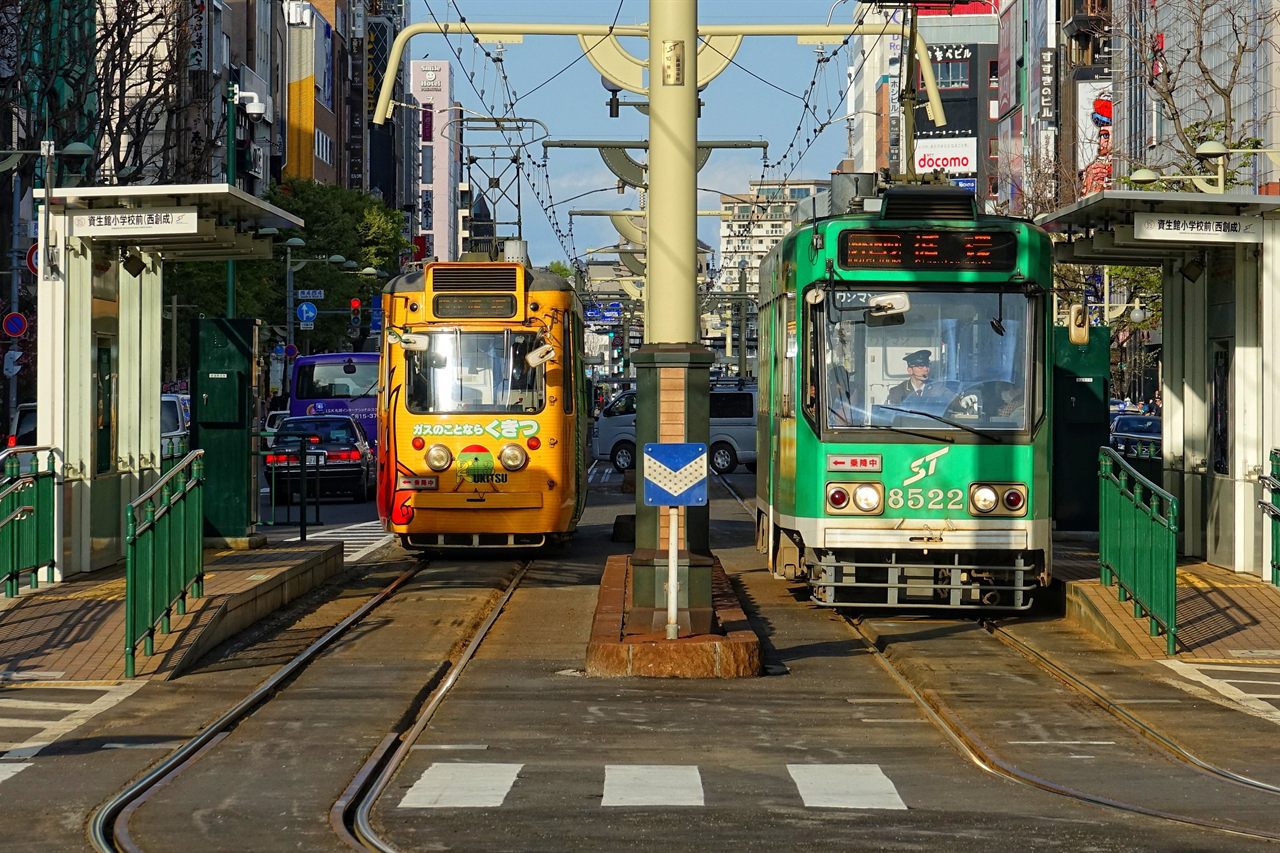
For Sapporo’s streetcar, check your direction, board at the rear, and pay as you leave through the front. Cash goes into the farebox; transit IC cards use their reader, while supported contactless bank cards use a separate terminal. You do not tap or take a ticket when boarding. Check the stop for your destination before you ride.
Confirm the direction, board at the rear and choose one payment route when leaving.
Match the stop and direction to your destination.
Use the rear entrance; no ticket or IC tap is needed on boarding.
Pay into the fare box at the front.
Tap the IC card reader at the front.
Tap the separate supported-card terminal at the front.
Exit from the front after the correct payment or valid pass check.
The three payment cards are alternatives, not consecutive steps. Follow the vehicle signs and operator guidance.
The basic sequence is to board at the rear and pay when leaving at the front. Choose the stop near your destination, compare the direction and select one payment method. This guide follows the journey through to reaching the place you came to visit.
A sightseeing loop and a journey to one destination are different plans
The route forms a loop. Two directions can reach the same destination while passing very different numbers of stops. Riding around to enjoy the view and getting to a booked restaurant therefore need different plans. Keep the sightseeing loop separate from the journey to a time-sensitive reservation.
Trace your current stop and destination on the route map, then read the vehicle’s destination display. Finding a shop in a map app is not yet a complete boarding plan if you have not selected its stop. Save both the stop name and the shop entrance to connect the ride with the final walk.
Transport IC cards and contactless bank-card payments use different readers. The first is a transport payment card; the second uses a supported credit, debit or similar bank card. Take out the one method you intend to use rather than presenting a wallet full of cards.
Start with the stop, not just the attraction
Save the attraction’s Japanese name, its nearest streetcar stop and the walk from that stop to the actual entrance. A station pin on a map is not the same as the museum or hotel entrance.
At the platform, check your current stop, direction and the stops along the way. Use crossings and signals to reach another platform; do not cross the road directly just because the tram is visible. If 内回り and 外回り are confusing, compare the intermediate stops on the route map. While the tram is stopped, you can show the destination and ask “○○へ行きますか?”—does this tram go to ○○?
Avoid distracting the driver while moving.
Boarding, step by step
- Let passengers get off and follow the door signs.
- Board at the rear. You do not take a numbered ticket or tap an IC card when boarding.
- Move clear of the doorway and hold your luggage securely.
- Watch the stop announcements and have your payment ready before arriving.
Vehicles can look different. Follow the signs on the actual tram rather than treating an illustration as an exact door layout. Keep suitcases from rolling into the aisle.
Pay when you get off
The regular fare is flat: ¥230 for adults and ¥120 for children, regardless of distance; check the official age categories for your group. Cash goes into the farebox according to its instructions.
If you need change, ask while the vehicle is stopped.
Transport IC cards, including Suica and Kitaca, are tapped at the reader when leaving. Supported contactless bank cards use a dedicated terminal; do not confuse that terminal with the transport-IC reader. Contactless bank-card payment on the tram began on 27 April 2026.
For child fares or several people paid with one bank card, tell the driver before tapping. Show a valid streetcar pass or its active mobile-ticket screen to the driver.
If a reader does not seem to respond, ask before tapping repeatedly. Open a mobile ticket in advance and make sure your phone has power.
Compare passes with journeys you will actually take
| Option | Listed price | Check first |
|---|---|---|
| Streetcar one-day pass | Adult ¥570; child ¥290 | Your journeys on that day |
| Dosanko Pass | ¥460 for one adult and up to two children | Saturdays, Sundays, public holidays and December 29–January 3 |
| 24-hour pass (mobile only) | Adult ¥840; child ¥420 |
A subway transfer ticket is also available: ¥360 for adults and ¥180 for children.
The streetcar one-day pass is sold on board and elsewhere.
At the regular adult fare, two rides cost ¥460 and three cost ¥690. On a weekday, three streetcar rides make the ¥570 pass ¥120 cheaper than those regular fares.
This example does not combine other discounts.
Eligible holiday contactless bank-card travel also has an adult fare-cap scheme. Read the official conditions and use the same card or device consistently: a physical card and a phone are not combined even if linked to the same card number.
Streetcar passes do not include the subway or bus. Donichika is a subway ticket, despite the similar-sounding name.
Getting off and solving problems
Watch for your stop and follow the onboard instructions for the stop-request button. Prepare without rushing through a moving vehicle.
Pay at the front and check the step and platform before leaving.
If you miss the stop, leave safely at the next one and check the return direction. Another ride may require another fare unless covered by a valid pass.
For wheelchair travel, the operator says some stops may require staff arrangements; contact them in advance with your stop and travel time. Check the platform approach, vehicle step and final pavement separately.
Japanese signs you may see
| Sign | Meaning |
|---|---|
| 乗車口 / 降車口 | Boarding door / exit door |
| 内回り / 外回り | The two loop directions; compare stops |
| 両替 | Change-making, not the fare-payment action |
| 終点 | This service ends here |
Official diagrams and fare details
The operator’s route and boarding guide shows the stop map, doors and payment readers. Use it to match the Japanese stop names saved on your phone; you do not need to translate every paragraph. The fare and pass page lists ticket conditions and contactless-payment rules. Checked September 29, 2026; follow current service notices and instructions on the day.
A café return trip compared with three separate boardings
For one adult going to a café and back, the model has two streetcar rides. At the listed ¥230 ordinary fare, that is ¥460. Add a separate journey to another stop and three rides total ¥690, which can be compared with a ¥570 streetcar day pass. This is simple arithmetic using the listed fares, without combining transfer discounts.
Three shops do not necessarily mean three rides. Walking between nearby shops may reduce the count; returning to the hotel may increase it. Write actual boardings and check the pass’s date and passenger conditions. Subway Donichika is a different product, so keep subway journeys in a separate column.
As your stop approaches, check the next-stop announcement and request button, and have your payment ready. Tell the driver before tapping for child fares or multiple passengers. If the reader’s response is unclear, do not keep tapping; ask while the vehicle is stopped. Avoid distracting the driver during travel or rushing through a moving carriage.
If you miss the stop, leave safely at the next one and work out the return direction. Once you have paid, stepped onto the stop and followed the route to the entrance, that journey is complete. There is still room to enjoy the view after the practical sequence makes sense.
Small details that make the day easier
The weekend bank-card cap belongs to the tram
On eligible weekends, holidays and 29 December–3 January, the tram’s bank-card cap is ¥460 for adult travel. Subway rides do not count toward it. Keep the same payment medium: a physical card and its phone version are not combined.
For a solo adult making three ordinary tram rides on an eligible day, the usual ¥690 total is capped at ¥460 with qualifying consistent taps. That is a ¥230 difference under those conditions, not a discount for every payment method. Weekdays outside the eligible period do not have this holiday cap.
On an eligible day, once an adult’s tram fares for that day reach ¥460 in total, no further tram fare is charged that day.
One family payment does not create several caps
If one card pays for a group, the operator applies the cap to only one adult’s fares; other passengers pay the normal amount. Tell the driver before tapping for several people or a child. Compare an eligible family pass separately, because its included passenger conditions can matter more than a solo-adult calculation.
Keep a note with the stop name, next stop in your direction, and the payment method you chose. For a return ride, check the direction again instead of waiting automatically where you got off. A loop map looks simple, but a reservation time still needs the shorter journey to the right stop.
Official sources checked 3 October 2026: Tram contactless rules
Official information and scope
This guide combines official information and planning proposals. No newly added passage claims a firsthand visit or ride. Check fares, services, opening hours and facility conditions for your travel date.