
Sapporo’s fire bureau counts this every winter: people who fall on snow or ice and are taken away by ambulance. In the 2025–26 season (November to March, preliminary figures), the count was 2,060 people. Almost 80% of them fell on roads — sidewalks and crosswalks. December alone accounted for 868, the month when visitors arrive for the snow and residents are still adjusting to it.
The city publishes specific guidance on how not to join that count. This article is that guidance, organised for someone visiting Sapporo for the first time: how to walk, where the slippery places are, what to wear on your feet, and one local system — free sand boxes — that most visitors walk straight past.
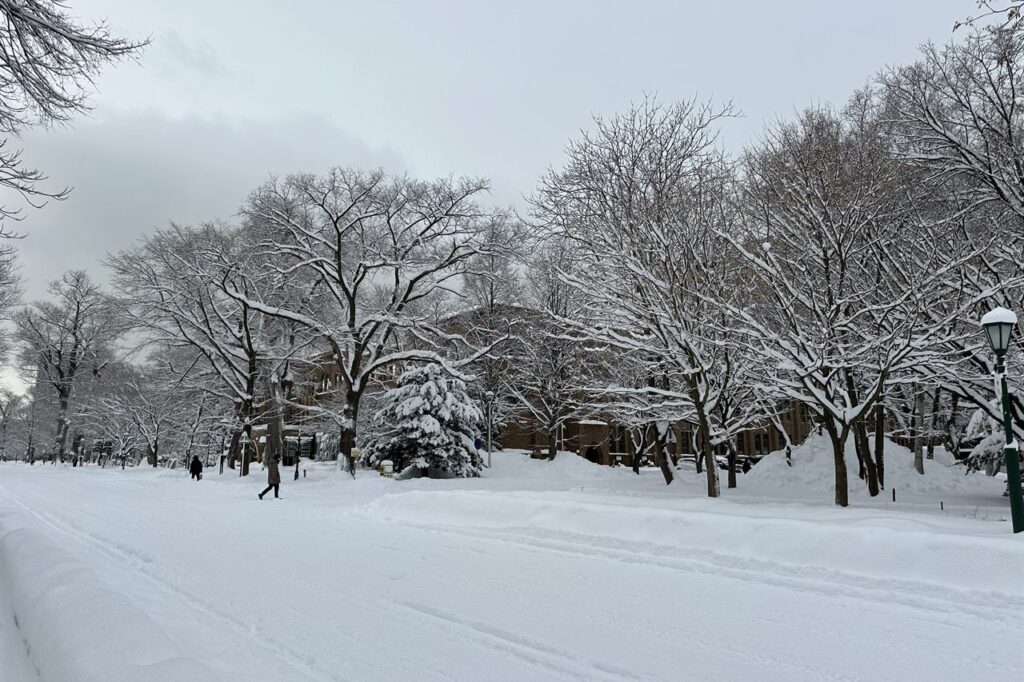
Quick answer: the city’s three rules
The Sapporo City Fire Bureau repeats the same three points every winter:
- Take small steps. A long stride lifts your foot high and swings your centre of gravity, which is how a slip becomes a fall. On a narrow path, keeping your feet roughly 20 cm apart also helps.
- Put your whole sole down. Walk with your weight slightly forward and as much of the sole in contact with the ground as you can manage — almost a shuffle, but lift your feet just enough not to trip.
- Do not rush. Walking with time to spare lets you spot a dangerous surface before you are standing on it. Walking while looking at your phone divides the attention you need for the ground.
And one more the city’s magazine adds: keep your hands out of your pockets, so a fall does not become a serious injury.
Visitors often call the small-steps, flat-sole style the “penguin walk”. The name is a nickname, not the city’s term — but the posture it describes is exactly what the city teaches.
Where the city says people fall
The fire bureau’s leaflet lists the places to treat with care:
- Crosswalks. Traffic and feet pack the snow down, and tyres polish the surface when cars pull away. The white paint of the crossing is singled out in the city’s magazine as especially slippery. The sidewalk near a crossing often slopes gently, too.
- Sidewalks where cars cross — the entrances to parking lots and driveways. Cars pack and polish the snow, and there is usually a slope down to the road.
- Bus and taxi boarding areas. Packed down by vehicles and crowds. Watch your footing most at the moment you step down from the vehicle.
- The entrances of underground malls and shops. Tile floors plus the snow and water on your soles is a reliable way to slide. Shake the snow off before you go in. Note the trap in reverse: winter boots with metal grip pins, excellent on ice, can be slippery on indoor tile.
- The edge of a road-heated stretch. Central Sapporo has sections of pavement with heating underneath that melts the snow. Where the heated section ends and the frozen section begins, there is a boundary — and the city’s magazine lists that boundary as a classic fall spot, because your pace and grip change without warning.
Two weather conditions make everything worse, per the city: daytime temperatures hovering around 0°C, and after rain, when meltwater and wet surfaces refreeze into a thin, hard, nearly invisible layer.
There is a local forecast for this. The Winter Life Association publishes a “tsurutsuru” (slippery) forecast for the next morning’s sidewalk conditions in Sapporo (7:00–10:00, central pedestrian areas), in three levels. The fire bureau’s page links to it. If the morning level is high, that is a day to use the underground walkway and the subway more, and the sidewalks less.
Footwear: the city’s three conditions and four soles
The fire bureau says a winter shoe for Sapporo needs three things: grip, waterproofing, and insulation. For the sole itself, it describes four types that work:
- Pinned or metal-fitted soles — sharp pins bite into hard ice. The same pins can slip or trip you on indoor tile and carpet.
- Deeply grooved soles — strong grip, but the rubber also needs to be soft; a hard sole with grooves still skates on polished ice, and grooves clogged with snow lose their grip.
- Soft rubber soles — the rubber itself adheres to the surface.
- Soles with abrasive material mixed in — the embedded grit scratches the surface like sandpaper as you step.
If your own shoes fail that test, the city’s official tourism site points to the local fix: slip-on anti-slip spikes, sold at convenience stores and shoe shops in central Sapporo for roughly ¥1,000–2,000. They strap over your regular shoes for the walk and come off indoors — which also solves the pin-on-tile problem above.
The sand boxes: free grip, maintained by the city
At intersections in central Sapporo and around subway stations, you will see city sand boxes. Inside are bags of grit. They are not decoration and they are not for city workers only: the city installs them so that people passing by can spread sand on a slippery crossing themselves, and it asks for exactly that cooperation — the sand you spread also protects the next person.
The city’s official how-to is three steps:
- Take a bag of sand out of the box.
- Open the cut corner of the bag.
- Spread the sand widely over the slippery area (a wide scatter works better than a pile).
Put the empty bag in the box’s empty-bag compartment. If a crossing looks like glass and there is a sand box beside it, using it is the locally expected thing to do.
Putting it together: a first-evening checklist
- Land, and before the first walk outside, check your soles against the four types above. If they are smooth fashion soles, buy slip-on spikes at a convenience store before you need them.
- Walk the fire bureau’s way from the first step: small steps, whole sole, no rushing, hands free.
- Slow down further at crosswalk paint, parking entrances, bus stops, shop doorways, and wherever a melted stretch of pavement ends.
- On a high-slipperiness morning, move the route indoors: the Chi-Ka-Ho underground walkway and the subway cover much of central Sapporo.
- Carrying luggage changes the problem from balance to route choice — see the winter suitcase guide for planning the walk from the station to your hotel.
- If you do fall and hit your head or cannot get up, call 119 (ambulance and fire use the same number across Japan). The city’s statistics include serious injuries every season; a fall on ice is a legitimate reason to use it.
None of this requires special skill — it requires knowing that polished ice at a crosswalk is a different surface from the snow beside it, and walking like it. Sapporo’s residents relearn that every December. Visitors can learn it before their first evening instead.
Sources
- Sapporo City Fire Bureau, ambulance transports from falls on snowy roads (prevention points and seasonal statistics, FY2025 preliminary): https://www.city.sapporo.jp/shobo/kyukyu/yukimiti/yukimiti.html and the FY2025 summary PDF linked from that page.
- Sapporo City Fire Bureau leaflet, “Tips for not falling on snowy roads” (walking points, slippery places, sole types): https://www.city.sapporo.jp/shobo/kyukyu/kyukyujikoyobou/documents/01yukimititenntou.pdf
- Koho Sapporo, December 2012 (crosswalk paint, road-heating edges, weather conditions, hands out of pockets): https://www.city.sapporo.jp/somu/koho-shi/201212/documents/20121203.pdf
- Sapporo City, sand boxes Q&A and icy-road measures: https://www.city.sapporo.jp/kensetsu/yuki/question/qa06.html / https://www.city.sapporo.jp/kensetsu/yuki/sagyou/type/06.html
- Sapporo City, road heating facilities: https://www.city.sapporo.jp/kensetsu/yuki/yukishisetsu/05.html
- Sapporo tourism association (official), winter walking tips and winter clothing pages (slip-on spikes, prices): https://www.sapporo.travel/en/useful_information/sapporo_winter_walking_tips/?lang=en / https://www.sapporo.travel/en/spot/feature/clothes_winter/