
Quick answer: choose the last 300 metres, not just the nearest station
In winter, a Sapporo hotel listed as “five minutes from the station” may still involve stairs, an outdoor crossing, and a snowy final pavement. Before choosing to walk with a suitcase, check three separate parts of the route: station platform to an elevator exit, indoor or underground passage, and the actual outdoor approach to your hotel door. If any part is uncertain, ask the hotel for its accessible exit and an alternative drop-off point. A taxi for the final portion may be simpler than struggling through snow with heavy bags; suitability and availability depend on conditions and location.
Sapporo City describes the Sapporo Ekimae-dori Underground Walkway (Chi-Ka-Ho) as a connection around central Sapporo, with connections to nearby buildings. This does not mean every hotel is directly connected, or that every indoor route is open at all hours. Check the actual exit and building opening times. Source: Sapporo City official walkway overview. For the walkway’s own exits and closing time, see the Chi-Ka-Ho walking guide.
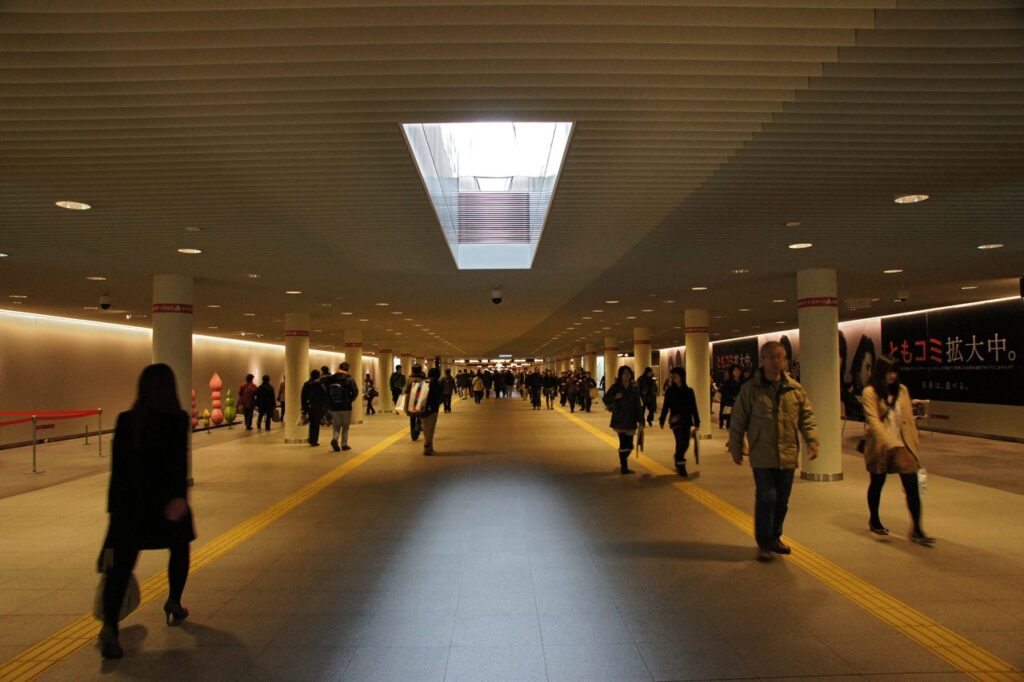
Pick your route in this order
| Your situation | First route to check | When to change the plan |
|---|---|---|
| One small suitcase, hotel directly connected underground | Indoor route plus building entrance | Connections closed or stairs only |
| Two rolling suitcases or a stroller | Elevator exit and step-free approach | Snow/ice on the last outdoor section |
| Hotel across a road from a station exit | Official crossing and entrance | Unsafe crossing or heavy accumulation |
| Arrival late in the evening | Hotel-provided late-arrival entrance instructions | Underground/building access unavailable |
| Wheelchair or mobility-related needs | Confirmed accessible route with hotel/station staff | Any unverified step or lift access |
Important: These are planning choices, not live accessibility assurances.
1. Save the hotel entrance, not just its map pin
Search for the precise building entrance and reception location. Shopping complexes, hotels and connected office buildings may have different doors. A map pin can be close to an underground exit while the entrance used after hours is on another street. Save the hotel’s address in Japanese and its phone number offline.
Ask the hotel: “Which exit has a lift and is easiest with a rolling suitcase in winter? Is any underground connection open when I arrive?” Do not treat a general route map as confirmation of a step-free path.
2. Break the trip into three segments
Segment A — train platform to street level. Look for elevators, not merely the shortest stair route. Confirm whether you’re at JR Sapporo Station or subway Sapporo Station: they are different facilities.
Segment B — sheltered central route. Sapporo’s official underground-walkway network is useful when it fits your destination. The municipality’s materials describe the network and connected buildings; check the current plan and actual wayfinding. Do not assume that the passage takes you straight into your hotel. Source: Official city walkway.
Segment C — last outdoor distance. Check the street crossing, gradients, steps and where you will wheel the bag. In snow or slush, a short section can be harder than the whole indoor walk. Stop somewhere safe to look at the map rather than steering the case and phone at once.
3. Decision: walk, use a taxi, or leave bags first?
- Walk when the step-free route and actual pavement conditions are manageable for everyone in your group.
- Taxi when luggage is heavy, the last section is exposed or the path cannot be checked confidently. Confirm pickup and drop-off with the provider; do not assume vehicle availability or quote a fixed fare.
- Hotel luggage storage may reduce the load before sightseeing; ask for acceptance times and rules, including what happens before check-in.
- Station locker/forwarding is a different solution if you don’t need everything today. See the Sapporo luggage storage guide for locker sizes, retrieval times and what to do when lockers are full, rather than assuming availability.
Related reading: Sapporo luggage storage guide, Chi-Ka-Ho walking guide, Sapporo station lockers guide.
4. Copyable questions to send your hotel
Hello. I will arrive at [station] on [date] around [time] with [number] suitcases. Which station exit and hotel entrance would you recommend in winter? Is there a step-free route, and is any underground connection open at that time? If the outdoor route is difficult, where can a taxi drop us off? Thank you.
If access is essential, request a specific answer rather than relying on a general “near the station” description.
5. Before leaving the station: six checks
- Check weather and official service notices for your arrival time.
- Confirm the exact hotel door and late-arrival entrance.
- Save the lift exit and plan B on your phone.
- Keep one hand free where practical; secure loose bags.
- Do not assume the surface is cleared or ice-free.
- If the route is unsuitable, ask station/hotel staff for a safer alternative.
What this guide does—and doesn’t—claim
This guide combines Sapporo City public information with travel-planning recommendations. It does not claim that the writer walked this route, stayed at a particular property, or checked live snow and accessibility conditions.
Primary source: Sapporo City, underground walkway overview (URL above).